
Venice 2026: Oasis: Don’t Look Back in Anger
Venice Film Festival 2026 Press Conference
179 ‘F’ bombs.
15 years of hurt.
Hundreds of thousands of emotional fans who got tickets.
Thousands of emotional fans who didn’t get tickets.
Multiple cities across the world.
Dozens of great songs
Several laugh out loud moments.
Many moments of unexpected tearing up.
Two warring brothers.
It could only be Oasis: Don’t Look Back in Anger.
Having thoroughly enjoyed the documentary charting the unexpected reunion of Noel and Liam Gallagher for a series of concerts in 2025, I rushed to join the lengthy queue for the press conference. It’s a first come first served system for the press conferences. For the popular ones you can expect to line-up for a couple of hours or so.
As we waited to be let in, one of the journalists shared live footage, on her phone, of Noel and Liam sailing in to the festival on a boat with the sort of swagger you’d expect from rockstars – Noel giving the Churchill peace sign and Liam raising a fist of triumph as photographers shouted for them to show their best side for the cameras.
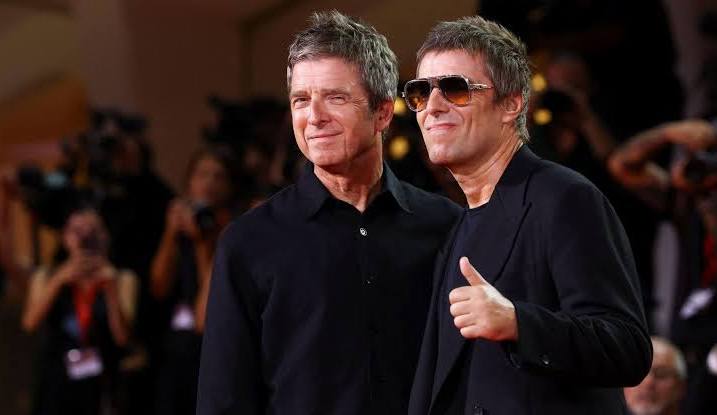
We also watched them, on a bigger screen in the press area, posing for the pre conference photo-call which happens behind the press conference hall.
Oasis were in the house! Excitement began to build. We all began to think of the questions we could ask during the press conference. We would, no doubt, receive funny, expletive laden responses.
There was a lot to ask about. The film is surprisingly moving and it’s not just because of the nostalgia factor. It tells a real story which if it was fictional, would lead people to roll their eyes and say, come on, that can’t be true. Except here it is.
Our queue moved quickly. I was one of the lucky ones. I got in.
There were only four nameplates on the table. Will Lovelace, Dylan Southern, the joint directors of the film. Stephen Knight the writer and the moderator.
What?
Where were Liam and Noel’s names?
The four named entered to applause but people were puzzled.
Where’s Oasis asked a number of European journalists?
‘I don’t know,’ said Stephen Knight, diplomatically. ‘They are around. They were here just a minute ago.’
The woman next to me was agitated. ‘They are here, she kept saying. She showed me the video of them meeting fans outside the press conference hall, on her phone, as proof. ‘So, why aren’t they coming in to the conference?’
Maybe they’ll surprise us and come in later,’ I soothed.
She wasn’t convinced and continued to look desolate.
The filmmakers started without their stars. They explained that discussions about making the documentary had risen largely from Noel Gallagher‘s astonishment at the response from the public to the announcement of the gigs. Different generations of fans were fighting for tickets and it seemed right to go in search of the answer to the question of why the music and band meant so much to them, through a film.
‘Why was this music born in Manchester connecting with people of all ages, the world over? That was what we wanted to explore,’ said Stephen Knight.
So, from the start, the filmmakers set up a team of researchers whose job it was to find fans who had genuine emotional connections to the songs. They were not looking for super fans but people for whom Oasis had a meaning beyond just a band with good tunes. Knight quoted one woman in South Korea who described their importance to her by saying ‘when you fall Oasis fall down with you but then when you’re ready to get up, they get up with you.’ He said the team found many other such stories of people who found escape from the harsh realities of their lives in the music of the band or felt that the group’s songs spoke to their experiences and made them feel they were not alone
Seeing the emotions of older fans singing along to the songs they loved in their youth or seeing young fans who weren’t even born when the band was at its peak connecting to those same songs is indeed touching. Few things can bring a crowd together like music and sport and the film making team capture that magnificently in the documentary.
Then there was the estrangement of the two brothers.
‘The world was interested in how the relationship might develop over the course of the tour,’ said Knight. ‘Would audiences see reconciliation on stage or would there be a bust-up partway through?’
Lovelace and Southern said their aim was to be invisible to the band, while filming. ‘We just turned the cameras on them and filmed what happened. We didn’t mediate in the relationship. These are real people, they weren’t following a script. They were two brothers who at the start couldn’t even bring themselves to greet each other as they began rehearsals. They’re British working class people. They’re not going to high five each other or hug. So, the first time Liam walked into rehearsals he immediately asked something about the drums. That’s how he dealt with it. It was over time that we saw these were two brothers, they were family and we began to see reconciliation, redemption and forgiveness. Our job was to capture where the story was going.’
The Gallaghers’ fifteen year long estrangement has been described as a musical Cain and Abel and there is something biblical in the rise and fall and rise of the band which centres around them.
Working class men from the lower end of Manchester, the sons and grandsons of Irish immigrants, they burst onto the music scene in the 1990s. Noel, the older brother was the songwriter, ‘our kid’, Liam was the one with the voice. “I don’t really sing” he explains in the film, “I just get all the anger out.”
They became the face of Britpop and what was heralded as a new era in British politics and culture in a decade filled with hope and creativity. Their personal fortunes followed the country’s fortunes as, after a period of success, everything turned sour and after a big break up, whilst on tour, the group acrimoniously disbanded.
The news, in 2025, of a professional reunion came out of the blue. The clamour for tickets was phenomenal. So, it was inevitable the filmmakers would want to capture the excitement of the fans as much as the ‘will they, won’t they make up’ story of the brothers.
‘In a way it was the crowds at the concerts which led the way. It was the love and excitement of the fans which spurred on the reconciliation on stage.’
It was important too, the two directors said, that the concerts be filmed from the fans perspective as much as possible. They wanted viewers of the film to be pulled into the excitement and to feel that they were there with them in the mosh pit or dancing in the seats. They acknowledged that it was the fantastic editing and cinematography of their team which achieved this so well.
Similarly, the directors did not want to cover the evolution of the band in the usual A to Z approach. Instead, they chose to ‘have the current story of the concerts and the reunion in direct dialogue with the past.’ This involved a melding of footage from the early years with film of the 2025 concerts with sound bites and narration, often hilarious, from the brothers themselves.
Stephen Knight admitted that a script writer could not have written funnier material.
‘Everything the brothers say in ordinary conversation could be slapped on a T-shirt, albeit not a T shirt you could wear in public, due to the language!’
Asked why the filmmakers had chosen a documentary approach as opposed to a feature film, Knight simply said ‘These are real people with a real story and it’s better than any fiction anyone could come up with. People have compared it to Peaky Blinders and I can see why. Plus, no one could play Liam, except Liam!’
True to form, the Gallagher Brothers did not make a surprise, last minute entrance into their own press conference! They preferred to go off goodness knows where instead. A pity because they would have been greeted with a great deal of warmth and enthusiasm.